1-2 Days in Bath: The Right Order to See Everything
Roman Baths, the Georgian circuit, Thermae Spa, and where to eat
How to see Bath in 1 or 2 days: Roman Baths before the crowds, the Georgian loop from the Circus to the Royal Crescent, the Thermae Spa at dusk, and the restaurants that are not overpriced.
1-2 Days in Bath: The Right Order to See Everything
Bath is a small city that rewards doing things in the right order. Start with the Romans, move through the Georgians, and end floating in hot spring water while looking at the Abbey they both built around. Most people rush through the Baths and miss the best photo spots, or hit Thermae Spa at noon when it's crowded and hot. Do this right and you'll understand why Bath exists at all.
Roman Baths, Abbey, and the Georgian Circuit
This is Bath in proper chronological order: Romans first, then the Abbey they inspired, then the Georgian city built around both. You'll walk the same streets Jane Austen walked, see the green Roman pool that started it all, and end floating in the same hot springs at dusk. It's a full day that moves from underground Roman engineering to rooftop spa views.
- Roman Baths at opening time
- The Circus and Royal Crescent
- Thermae Spa at sunset
Morning: Roman Baths and Abbey (9 AM - 12 PM)
Get to the Roman Baths at 9 AM sharp with skip-the-line tickets booked online (GBP 26). Without them, you're looking at 45-60 minutes in queue during peak season, and the morning light on the Great Bath is worth getting up early for. The green water steams year-round at 46°C, and that first view when you walk onto the terrace explains why the Romans built here 2,000 years ago. The museum builds logically from that central pool, but it's the water itself that matters, not the artifacts. Use the audioguide: Bill Bryson narrates it and actually makes the Roman engineering interesting. Allow 1.5-2 hours total.
Bath Abbey is literally next door, so walk over while the morning light is still coming through the west windows. Entry is free with a GBP 4 suggested donation. The fan-vaulted ceiling is what everyone photographs, but look first at the west facade outside: those are angels climbing ladders to heaven, carved in Bath stone that's been darkening for 500 years. Inside, the nave feels taller than it is because of the vertical lines in the stonework. This is where they held services while the Roman Baths were being excavated right next door.
Pop into the Pump Room before you leave this area. Entry is free if you're not eating, and you can taste the spa water from the fountain for the authentic Bath experience. It's warm, iron-heavy, and genuinely unpleasant, but this is the same water the Romans and Georgians came here to drink. The room itself is worth seeing: high ceilings, tall windows, and usually a pianist playing morning classics. If you want the full afternoon tea experience, book ahead (GBP 35-45), but the coffee and Bath buns are perfectly good and much cheaper.
Late Morning to Early Afternoon: The Georgian Circuit (12 PM - 4 PM)
Walk up Gay Street from Queen Square. This is the same route Jane Austen took daily when she lived at 4 Sydney Place, and you'll understand why she found Bath claustrophobic: the Georgian streets funnel you along specific routes between the set pieces. The Circus comes first, and it's better than the photos suggest. Three identical curved terraces form a perfect circle around a small park of plane trees. The carved frieze along the first floor is full of Masonic symbols and esoteric references that most visitors walk past without noticing. Stand in the center of the circle and look up: John Wood designed this as an inverted Colosseum, Roman architecture turned inside out.
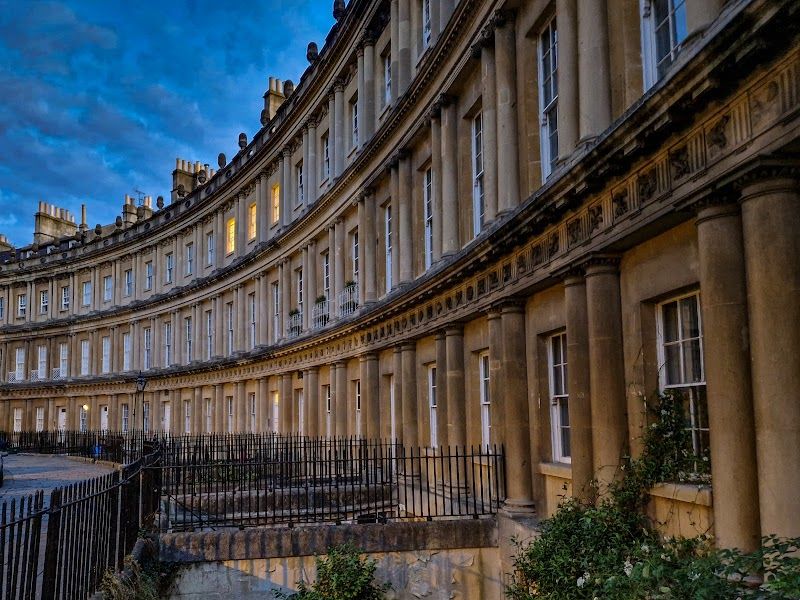
Brock Street connects the Circus to Royal Crescent in a perfectly straight line. This is Georgian town planning at its most theatrical: each vista is designed to surprise you. Royal Crescent is the most photographed Georgian facade in England for good reason. 114 Ionic columns sweep in a perfect arc, and the Bath stone turns honey-gold in afternoon light. Walk the full length from east to west to see how the perspective changes. No. 1 Royal Crescent (GBP 12.50) shows you a complete Georgian interior if you have time, but the exterior is the real attraction.
The Assembly Rooms on Bennett Street are free to enter and give you the best Georgian interior in Bath. The Ballroom is 30 meters long and lit by five crystal chandeliers that still work. This is where the social season happened: dancing, card games, and the marriage market that Jane Austen wrote about. The Fashion Museum in the basement (GBP 9.50) covers costume history if you're interested, but the rooms upstairs are the real draw.
Afternoon: Thermae Bath Spa (5 PM - 7 PM)
Book Thermae Bath Spa in advance for a 5-6 PM slot (GBP 42 for 2 hours). This timing puts you in the rooftop pool at dusk, when the air is cooling and the Abbey is starting to light up. You're floating in the same hot spring water that fed the Roman Baths, 36°C year-round, with a direct view of the Abbey tower. The indoor pools are fine, but the rooftop experience is why you're here. The water feels softer than normal pool water because of the mineral content, and the view changes as the light fades. This is the best version of what Bath has always been about: hot water and a view.
Evening: Dinner
For dinner, skip the restaurants near the Roman Baths and head to Kingsmead Square or Walcot Street, where the food is better and cheaper. Expect GBP 20-35 for mains. The Scallop Shell on Monmouth Street does excellent fish and chips (GBP 14-18) in a proper restaurant setting, or Acorn Vegetarian Kitchen on North Parade for creative plant-based food (GBP 16-22). If you want the Bath institution, Sally Lunn's at 6 North Parade Passage serves the original Bath bun (GBP 8-12) in the oldest house in Bath, built on Roman foundations.
Pulteney Bridge and Prior Park
Day two is about seeing Bath from different angles: the famous bridge from below, the city from above, and the landscape garden that gives you the best elevated view available to the public. This is a gentler day with more walking and outdoor time, perfect if yesterday was your first encounter with Georgian architecture and Roman engineering.
- Pulteney Bridge from riverside level
- Prior Park's Palladian Bridge
- Best panoramic view of Bath
Morning: Pulteney Bridge and Great Pulteney Street (9 AM - 12 PM)
Start at Pulteney Bridge, but don't just walk across it. Take the steps down to riverside level and turn back to look up: the three arches with shops built into the bridge structure and the weir cascading below is the classic Bath view. This is one of only four bridges in the world with shops built across its full span on both sides, and from river level you can see why the Georgians were proud of their engineering. The morning light hits the Bath stone directly, and you'll get the shot that's on every Bath postcard.
Walk the length of Great Pulteney Street to the Holburne Museum. This is the grandest Georgian street in Bath, designed as a single architectural composition leading to Sydney Gardens. The museum itself (free for permanent collection) has excellent Gainsborough portraits and Georgian silver that shows you how the people who lived in these houses actually lived. The building was originally the Sydney Hotel, where people stayed during the Bath season. Allow an hour if you like portrait paintings, 30 minutes if you just want to see the best Georgian interiors.
Parade Gardens by the river (GBP 1-2 in summer) gives you the bridge view from the south bank and deckchairs if you want to sit by the Avon. This is the best low-level photography spot for Pulteney Bridge, and in spring the garden beds frame the shot nicely. The weir sounds louder from this side, and you can see how the Georgians integrated the river into their urban planning.
Afternoon: Prior Park Landscape Garden (1 PM - 4 PM)
Take the First Bus number 2 from Dorchester Street to Prior Park (10 minutes, GBP 2.50). There's no car park at the garden, which keeps the crowds down. This National Trust property (GBP 10 entry) has the only Palladian bridge in England that you can actually walk across, and the view from the top terrace looking north over Bath is the best elevated panorama of the city available to the public. You can see how the Georgian city fits into the Avon valley, with the Abbey and Roman Baths at the center and the crescents climbing the hillsides.
The garden slopes downhill through different landscapes: formal terraces near the house, then parkland, then the Palladian bridge at the bottom crossing a small lake. Alexander Pope helped design the layout, and you can see his influence in the way each view is composed like a landscape painting. Allow 1.5-2 hours to walk the full circuit. The climb back up is steeper than it looks, but the changing views of Bath make it worthwhile.
Optional: Jane Austen Centre
If you're an Austen reader, the Jane Austen Centre at 40 Gay Street (GBP 14) covers her five years in Bath (1801-1806) thoroughly. The museum explains how her time here influenced Northanger Abbey and Persuasion, and shows you exactly where she lived and walked. The Georgian period details are excellent, and you'll understand why she found Bath both fascinating and frustrating. If you've never read Austen, skip it: the museum assumes you know the novels. Allow 45 minutes.
Practical Notes
Book Roman Baths and Thermae Spa tickets online in advance. Both sell out in peak season.
Bath is compact: everything on this itinerary is walkable except Prior Park.
The city gets very crowded 11 AM-3 PM. Start early or visit major sites after 4 PM.
Bath stone looks completely different in morning light versus afternoon light. Plan your photos accordingly.
Most Georgian interiors are free to visit. The exteriors are what you're really here to see.
Ready to Visit Bath?
Get a personalized itinerary tailored to your travel style and interests.
Plan Your Bath TripMore Bath Guides
First Time in Bath: What You Need to Know
Everything before your first visit: what the hot springs actually are, which Georgian buildings matter and why, what Jane Austen thought of Bath (she hated it), and how to get around without a car.
6 min
Eating in Bath: Where to Go Beyond the Tourist Centre
Bath has good food if you know where to look. The tourist zone near the Baths is expensive for what it is. Two streets away the prices drop and the quality improves.
5 min