Best of Montmartre: A Walking Guide
The village within the city, street by street
Most people do Montmartre wrong. They take the funicular up, fight through Place du Tertre portrait artists, look at Sacré-Cœur, and leave. That's 20 minutes of the worst part of a 3-hour neighborhood. The real Montmartre is cobblestone lanes that feel like a provincial village, artist studios where people are actually making art (not selling caricatures to tourists), and wine bars where the owner pours you something you've never heard of and it's excellent. This guide starts at Abbesses metro - not Anvers, which dumps you at the tourist gauntlet - and takes you up through the streets where Van Gogh, Renoir, and Toulouse-Lautrec actually lived. You'll pass the last two windmills in Paris, a working vineyard, and the most photographed pink house in the city. We'll tell you which corners to skip, where to stop for lunch that doesn't cost €18 for a sad croque monsieur, and exactly when to visit so you get the village atmosphere instead of the theme park version.
Getting There Right
Take metro line 12 to Abbesses, not Anvers. This isn't preference - it's strategy.
Anvers dumps you at the bottom of the tourist gauntlet, a steep staircase lined with €3 Eiffel Tower keychains and "I Heart Paris" t-shirts that smell like polyester regret. Abbesses drops you in the village heart, surrounded by locals buying bread and actual good cafes.
The metro entrance itself is worth the €2.15 ticket - it's one of only two original Art Nouveau Guimard designs left in Paris. Those curving green ironwork stems growing out of the ground? That's the real deal from 1900.
If your knees can't handle hills (and Montmartre is basically vertical), take the Montmartrobus from Place Pigalle. It's a regular bus that winds up to the top using the same metro ticket. Zero stairs, maximum smugness.
The Walking Route
Place des Abbesses
Start at that Art Nouveau metro entrance - those curving green stems are 1900 originals. The "Wall of Love" in the small park has "I love you" in 250 languages. It's cheesy as hell, but it works. Take the photo, move on.
Rue Lepic
This winding market street is where Van Gogh lived at number 54 with his brother Theo - there's a small plaque if you're into that. Walk past the Moulin de la Galette, one of Paris's last two windmills and the one Renoir painted. The morning market here has been running since the 1800s.
Musée de Montmartre
Renoir's actual studio, now a museum that smells like old wood and oil paint. Skip the indoor exhibits and head straight to the Renoir Gardens out back. They overlook Paris's last vineyard and are the most peaceful spot on the hill. €12 entry, gardens included.
Clos Montmartre Vineyard
Paris's last working vineyard, planted in 1933 and visible through the fence from Rue des Saules. The wine it produces is honestly terrible, but the October harvest festival turns the whole neighborhood into a three-day street party. Worth timing your trip around if you're here in fall.
Place du Tertre
Yes, it's touristy. Yes, most portrait artists are painting by numbers. But walk through - don't sit. The square itself is genuinely pretty 18th-century architecture when it's not packed. Everything on the square costs €18 and tastes like disappointment.
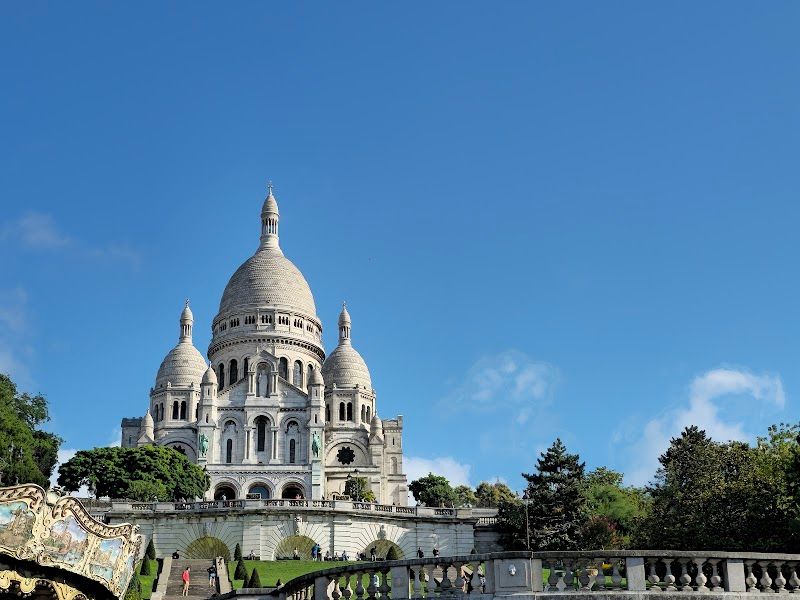
Sacré-Cœur
Skip the €8 dome climb - the view from the front steps is identical and free. Go inside for the massive Byzantine mosaic covering the ceiling, all gold and deep blues. Then sit on the steps with a €2 can of beer from the corner shop and watch Paris spread out below you.
Rue de l'Abreuvoir
Save this for last because it's the most photogenic street in Paris. La Maison Rose (the pink house), ivy-covered walls, cobblestones that catch the light just right. Come in late afternoon when the tour groups have gone and everything turns golden.
Where to Eat & Drink
Le Consulat
CafeMontmartre
The classic corner cafe with red awnings that's been in every Montmartre movie. Good for a €3.50 café au lait and people-watching at those tiny round tables that wobble on cobblestones. Skip the food - it's overpriced tourist fare that tastes like it came from a microwave.
Le Relais de la Butte
BistroMontmartre
A neighborhood bistro the tourist crowd walks right past, which is exactly why the duck confit falls off the bone and the wine list has bottles under €25. The waiter wears an actual apron and remembers what you ordered. This is what you came to Paris for.
The €15-18 lunch formule is genuinely good value. Dinner jumps to €28-32 but you're paying for the same quality.
La Cave des Abbesses
Wine BarAbbesses
Natural wine bar run by people who taste everything they pour. Tell them you like "something light and weird" and they'll hand you a glass of pét-nat that tastes like summer peaches for €7. The cheese plates smell like a farm in the best way.
Hardware Société
BrunchMontmartre
Australian-run brunch spot where the ricotta hotcakes are genuinely fluffy and the flat whites taste like Melbourne. €16 for hotcakes, €4.50 for proper coffee. Get there before 10:30 or you'll wait 45 minutes watching hungover locals check their phones.
Insider Tips
Wear shoes with grip. Montmartre's cobblestones turn into ice rinks when wet, especially the steep bits near Sacré-Cœur. We've watched people in heels slide down Rue Lepic like they're skiing. It's not pretty.
The string bracelet guys near Sacré-Cœur will grab your wrist and demand €5 for friendship bracelets you didn't ask for. Hands in pockets, no eye contact, keep walking. Don't engage even to say "non merci" - they take any response as encouragement.
Come before 10am or after 5pm to avoid the tour bus invasion. Early morning smells like fresh bread from the boulangeries. Late afternoon has that golden light that makes every photo look professional. Midday feels like Disneyland.
Walk down through South Pigalle (SoPi) instead of retracing your steps. It's become one of Paris's best dining neighborhoods - Rue des Martyrs alone has more good restaurants than most arrondissements. Take metro line 12 from Pigalle back to wherever you're staying.
Ready to Visit Paris?
Get a personalized itinerary tailored to your travel style and interests.
Plan Your Paris TripMore Paris Guides
3 Days in Paris for Art Lovers
You don't come to Paris for three days to tick museums off a list - you come because this is where art lives in your daily coffee run, not just behind velvet ropes. Walk down any street and you'll pass 18th-century sculptures used as actual street corners, gallery windows that change every two weeks, and bistros where the owner's personal Picasso sketch hangs next to the wine list like it's no big deal. The sequencing here isn't random. We're moving through art history chronologically - Day 1 classical masters (Louvre, Orangerie), Day 2 impressionists (Orsay, Rodin, Left Bank galleries), Day 3 modern and what's happening now (Centre Pompidou, Montmartre). Each morning anchors you in a major museum when your brain's fresh, each afternoon turns you loose in neighborhoods where artists actually work. We save Montmartre for last because ending where Picasso and Renoir actually painted, looking down at the city you've been walking through for three days, feels like the only way to finish. Plus by Day 3, you'll understand why they all came here.
3 min read

5 Days: The Complete Paris Experience
Five days is when Paris stops being tourism and starts being temporary residency. Three days and you're sprinting between landmarks. Four and you catch your breath. Five and you've got a favorite bakery, a shortcut through a courtyard that saves two minutes, and the dangerous feeling that maybe you could just... stay. We've front-loaded the big sights so you can ease into the real stuff. Days 1-3 hit the landmarks everyone comes for. Day 4 takes you to Versailles - which sounds like more tourism but actually makes you appreciate Paris more when you come back to human-scale streets and €2.50 café noisettes. Day 5 is when you stop looking at maps and start acting like someone who just happens to live here for a week.
4 min read
Paris on a Budget: A Practical Guide
Look, Paris doesn't have to cost €200 a day. I've spent weeks there spending €50 without once feeling like I was slumming it. The secret isn't suffering through bad meals and skipping museums - it's knowing which things are overpriced and which are practically free. A croissant from the best bakery in the neighborhood costs €1.20, same as one from the worst. The Sacré-Cœur steps have a better view than most paid observation decks. And a bottle of Côtes du Rhône from a cave costs €6 - what you'd pay for one glass at a tourist cafe. Here's how to do Paris right for €50-70 a day, without once feeling like you're missing out.
3 min read