First Time in Strasbourg: What You Need to Know
Winstub culture, the Christmas market, Alsace wine, bilingual Alsace, and getting around
Everything before your first visit: what a winstub is and what to order, how the Christmas market actually works, which Alsatian wines to drink, the bilingual street signs, and the tram.
WINSTUB CULTURE
A winstub is an Alsatian wine bar, from Wein-Stube, literally a wood-panelled room where you drink wine. Picture bare wooden tables, bench seating, and menus that haven't changed since the 19th century. The food is heavy, the portions are large, and everything pairs with Alsatian wine. Start with tarte flambee, which costs EUR 10-14 and arrives as a thin flatbread topped with fromage blanc, onions, and lardons. Eat it folded like a taco and order two per person if you're actually hungry, because one is more of an appetizer. Choucroute garnie is sauerkraut with five different types of pork for EUR 17-22. It's a meal for cold weather and serious appetites, and one portion feeds one very hungry person or two normal ones. Baeckeoffe is a three-meat casserole braised in Riesling that costs EUR 18-24 and tastes best in winter when the steam rising from the pot makes sense. The wine is always Alsatian: Riesling is dry and mineral, Gewurztraminer is aromatic and floral, Pinot Gris is full-bodied. A glass runs EUR 4-7. Go to Chez Yvonne on Rue du Sanglier, but you need reservations. Zum Strissel on Place de la Grande Boucherie has been operating since 1920 and feels like it. Au Coin des Pucelles gets fewer tourists but serves the same food.
CHRISTMAS MARKET
The Christkindelsmärik runs from the last Saturday of November to December 24 and has been happening since 1570, making it the oldest Christmas market in France. Three hundred wooden chalets fill Place Broglie and the cathedral square, drawing 2 million visitors in five weeks. Book your hotel by September at the absolute latest because the good hotels sell out months ahead. Weekday evenings are manageable, weekend afternoons are a mob scene. Drink vin chaud, which is mulled wine for EUR 4-5 served in a ceramic mug with a EUR 2 deposit. Return the mug at any stall to get your deposit back. Buy bredele, which are traditional Alsatian Christmas cookies, and pain d'epices, the local spiced gingerbread. The best photos happen 30 minutes after sunset when the illuminations are on but the sky is still deep blue, not black. Yes, it's touristy, but it's also been running for 450 years, so the tourism is justified.
ALSATIAN WINE
The Route des Vins d'Alsace starts 30 minutes from Strasbourg and runs through villages that look like fairy tale illustrations. Riesling is the signature wine of the region: dry, mineral, and perfect with tarte flambee and choucroute. Gewurztraminer smells like roses and lychees and works with foie gras and strong cheese. Pinot Gris is full-bodied and handles rich food well. Cremant d'Alsace is the local sparkling wine and costs EUR 10-16 a bottle if you buy it from small producers. A glass in a winstub costs EUR 4-7. A bottle from a small producer on the wine route runs EUR 8-20, which is a bargain compared to what you'll pay for the same wine in Paris. Take the train to Colmar in 35 minutes, which is the gateway to the wine villages. Riquewihr is the best single village if you only have time for one.
THE BILINGUAL THING
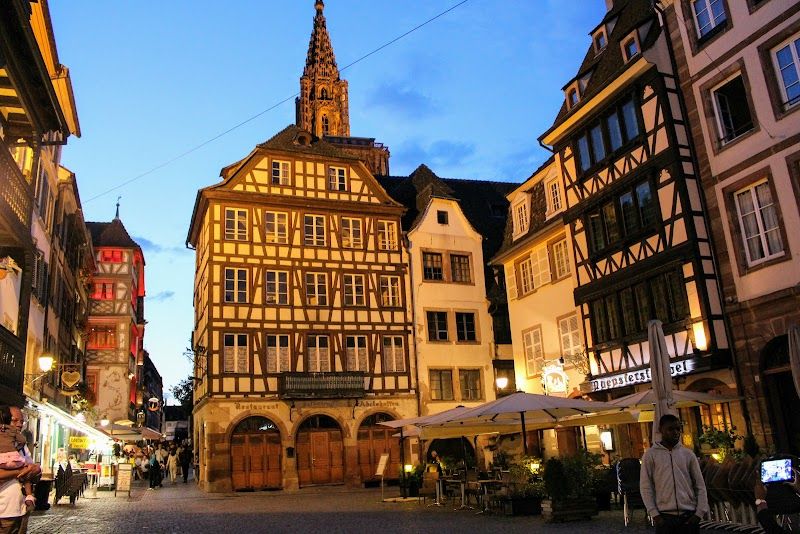
Strasbourg has been French and German so many times that the city stopped choosing sides. Street signs are in French, but menus in winstubs use Alsatian names. Tarte flambee is also called flammekueche, the Christmas market is the Christkindelsmärik, the covered bridges are the Ponts Couverts. Some older residents still speak Alsatian dialect, which mixes French and German in ways that make sense to no one else. The buildings from the German annexation period between 1871 and 1918 look like they belong in Frankfurt, with their heavy stone and Gothic revival details. The buildings from French periods look like Lyon, with their cream-colored stone and wrought-iron balconies. The cathedral was started by German emperors and completed under French rule. This isn't confusing if you accept that Alsace simply is both things at once, and always has been.
TRANSPORT
The tram network has six lines and costs EUR 1.80 for a single ride or EUR 5.20 for a day ticket. The tram covers the Grande Ile, where Homme de Fer is the central hub where all lines meet, the European Quarter at the Parlement Europeen stop, and the residential neighborhoods beyond. The Grande Ile itself takes 15 minutes to walk across, so you won't need the tram much in the old town. Velhop bike rental costs EUR 1 per hour from docking stations around the city and makes sense for reaching the Orangerie park or the European Quarter. Strasbourg is completely flat, so cycling is easy. The Strasbourg Pass costs EUR 22.50 for three days and covers trams, entry to two museums, and the boat tour around the canals. It pays for itself if you use the tram daily and visit at least one museum.
Ready to Visit Strasbourg?
Get a personalized itinerary tailored to your travel style and interests.
Plan Your Strasbourg TripMore Strasbourg Guides
2 Days in Strasbourg: First-Timer's Itinerary
How to spend 2 days in Strasbourg: climb the cathedral spire at opening, wait for the astronomical clock, walk Petite France before 9 AM, eat in a winstub, and get to Colmar or the wine route on day two.
7 min
Eating and Drinking in Strasbourg: Winstubs, Tarte Flambee & Alsace Wine
Strasbourg food guide: winstub etiquette, tarte flambee (the real version), baeckeoffe, and which Alsace wines to order in what order.
6 min