Italy
Venice
118 islands, 400 bridges, EUR 1.50 cicchetti at a bacaro, and a Grand Canal that stops you in your tracks
Best Time
April-June and September-November
Ideal Trip
2-3 days
Language
Italian, English widely spoken in tourist areas
Currency
EUR
Budget
EUR 101-156/day (excl. hotel)
About Venice
Venice is the city that should not exist and knows it. 118 islands connected by 400 bridges over 150 canals, built on wooden pilings driven into the mud of a lagoon, sinking at a rate that scientists measure in millimetres and politicians measure in excuses. The acqua alta floods are getting worse, and the city now charges a day-tripper entry fee (EUR 5) because 30 million visitors a year were destroying the place. None of this changes the fact that the first time you step out of Santa Lucia train station and see the Grand Canal, you will stop walking and stare.
The tourist Venice is San Marco: the Basilica (free, the golden mosaics covering every surface are Byzantine and overwhelming), the Doge's Palace (EUR 30, the council chambers, Tintoretto's Paradise, the Bridge of Sighs), the Campanile (EUR 10, the view covers the whole lagoon). All of this is magnificent, all of it is packed, and all of it is more expensive than the rest of the city. A coffee at Caffè Florian in the piazza costs EUR 12 standing, EUR 20 sitting. This is not a scam. This is Florian's pricing since 1720.
The Venice that justifies the trip is the one you find by getting lost, which in Venice is not a metaphor but a transportation strategy. Walk away from San Marco in any direction and within 10 minutes you will be in a neighbourhood where the laundry hangs across the canals, the bacari serve cicchetti (Venetian tapas, EUR 1.50-3 each) with a glass of house wine for EUR 2-3, and the only other people are Venetians going about their day. Dorsoduro has the Peggy Guggenheim Collection and the Accademia Gallery. Cannaregio has the Jewish Ghetto (the world's first, 1516) and the best-value restaurants. The vaporetto number 1 down the Grand Canal is the best EUR 9.50 sightseeing tour in Europe.
Neighborhoods
Each district has its own personality
San Marco
The monumental core of Venice: Byzantine gold mosaics, Gothic palace facades, the Bridge of Sighs, and a piazza Napoleon called the drawing room of Europe
Dorsoduro
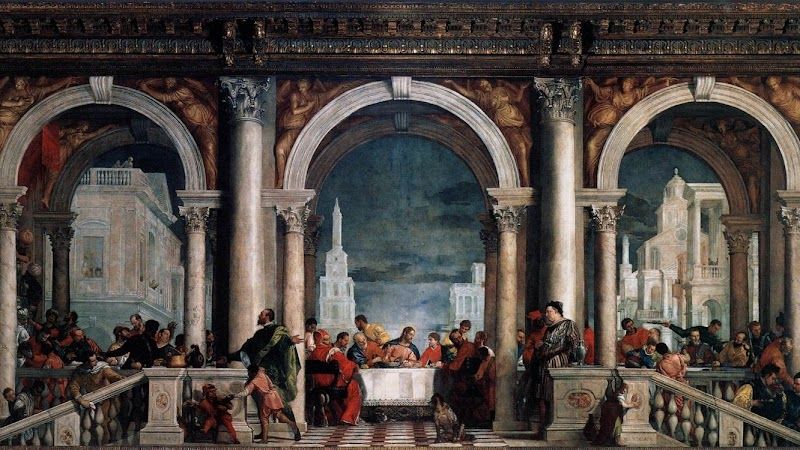
The art and student neighbourhood on the south bank: two of the best museums in Venice, the Grand Canal entrance with the Salute dome, Campo Santa Margherita for cheap spritz, and the Zattere waterfront walk
Cannaregio
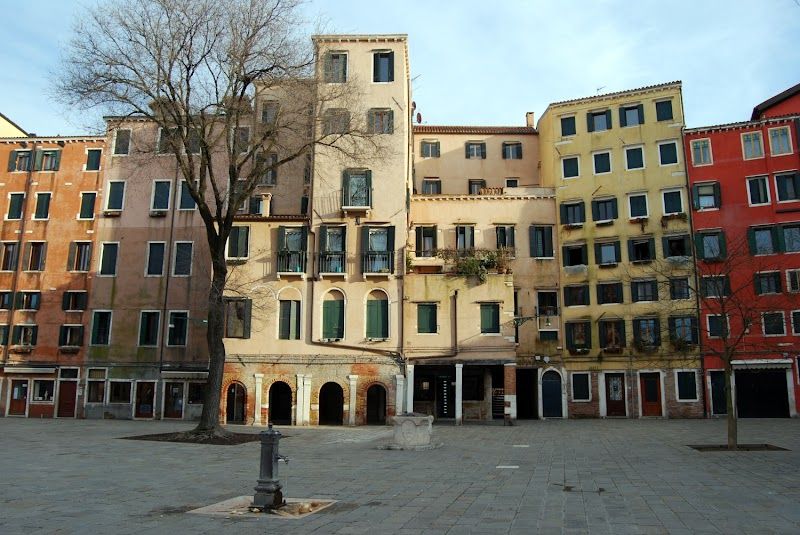
The most residential sestiere: the world's first Jewish Ghetto, the best bacari strips in Venice, Ca'd'Oro Gothic palace on the Grand Canal, and laundry lines where the tourist density drops to nearly zero
Things to Do
Top experiences in Venice
Rialto Bridge and Market
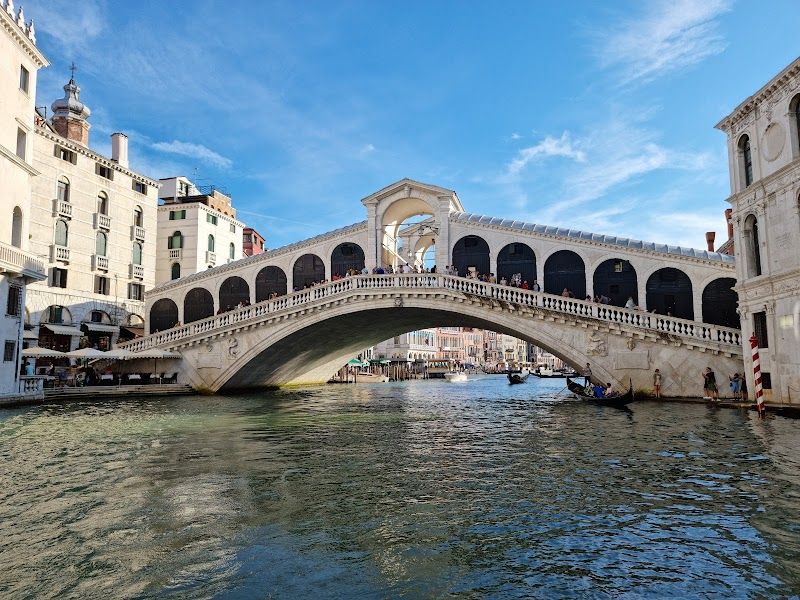
The Rialto Bridge spans the Grand Canal as Venice's oldest crossing, completed in 1591 with shops built right into its stone structure. You'll climb two inclined ramps lined with jewelry stores and souvenir shops to reach the central viewing point, where everyone stops for the classic Grand Canal photo. The real draw is the morning market on the San Polo side: Italy's finest fish market (Tuesday to Saturday, 7 AM to 12:30 PM) where Adriatic catches arrive daily, plus a produce market selling vegetables from the lagoon islands. The bridge itself gets packed by 10 AM, but the market area feels authentically Venetian as vendors shout prices and locals inspect the day's catch. You'll see fish species that don't exist outside Italy while dodging restaurant chefs making their morning purchases. The surrounding bacari (wine bars) like Al'Arco and Do Mori start serving cicchetti from 10 AM, where you can grab an ombra (small wine, EUR 1.50 to 2) and watch the market action. Most visitors rush across the bridge for photos and miss the market entirely, which is backwards. The bridge shops sell overpriced tourist goods, so save your euros for the bacari. Come before 10 AM when the fish market is at full energy and the bridge isn't shoulder to shoulder with tour groups. Skip the jewelry stores completely.
Doge's Palace (Palazzo Ducale)
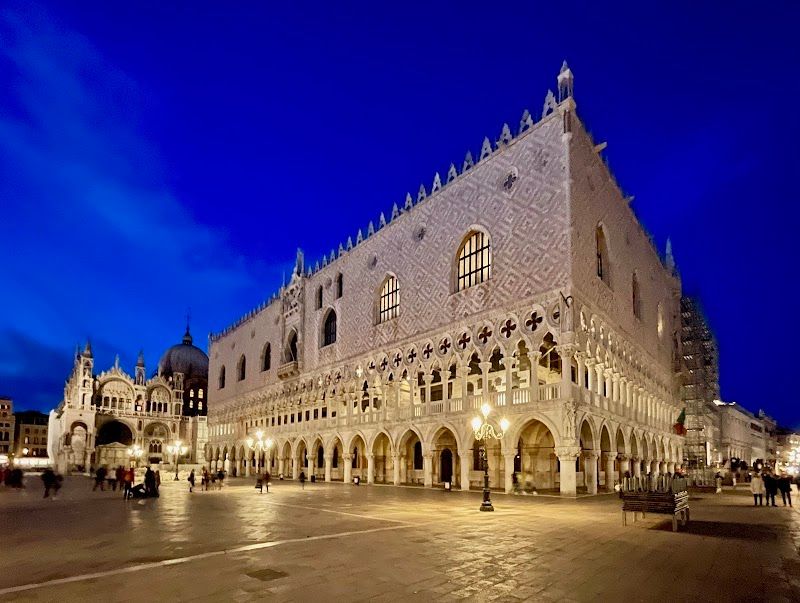
The Doge's Palace was the seat of Venetian government for a thousand years and the most important Gothic civic building in the world. The exterior is a visual paradox: the building appears to stand on a lace of pointed arches and marble screens, with the heavy upper mass of pink and white diamond-patterned stonework sitting on top. Inside, the Council chambers are overwhelming in scale and decoration. The Sala del Maggior Consiglio is 52 metres long and the walls are covered in massive paintings including Tintoretto's Paradise on the back wall, which at 22 by 7 metres is the largest oil painting in the world. The Bridge of Sighs connects the palace to the old prison: the name comes from prisoners sighing as they glimpsed their last view of Venice through the small windows. The Armory (upstairs) has the actual armour of Doge Francesco Morosini including his horse's armour. EUR 30 includes Museo Correr, Museo Archeologico Nazionale, and the Monumental Rooms of the Biblioteca Nazionale Marciana. Book online to skip the ticket queue. The Secret Itineraries tour (EUR 30 extra, separate booking) goes behind the scenes to the interrogation rooms and the prison where Casanova escaped in 1756.
Basilica di San Marco
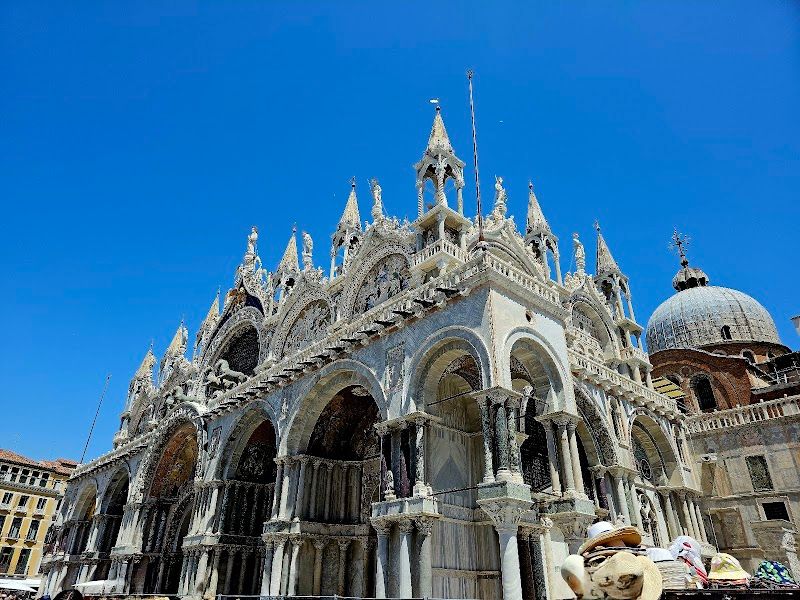
The Basilica di San Marco is the most important building in Venice and one of the most extraordinary interiors in Europe. It was built to house the remains of St Mark, smuggled out of Alexandria in 828 AD under a cover of pork fat (to deter Muslim customs inspectors). The exterior is five-domed Byzantine, covered in marble, gold mosaic, and sculpture looted from Byzantium after the Fourth Crusade, including the four bronze horses above the central door (the ones visible today are copies, the originals are in the museum upstairs). The interior is almost entirely covered in gold mosaic, 8,000 square metres of it, depicting biblical scenes and saints. The effect is not of a church but of a cave of gold. The Pala d'Oro behind the main altar is the high point of medieval goldsmith work: a jewelled altarpiece started in 976 and expanded over four centuries. Free entry to the main basilica (join the free queue on the left side of the piazza, not the paid fast-track queue, the wait is rarely more than 30 minutes). EUR 7 for the museum level above, which has the original bronze horses and much better mosaic views. Modest dress required (shoulders and knees covered), free covers available at the door.
Peggy Guggenheim Collection
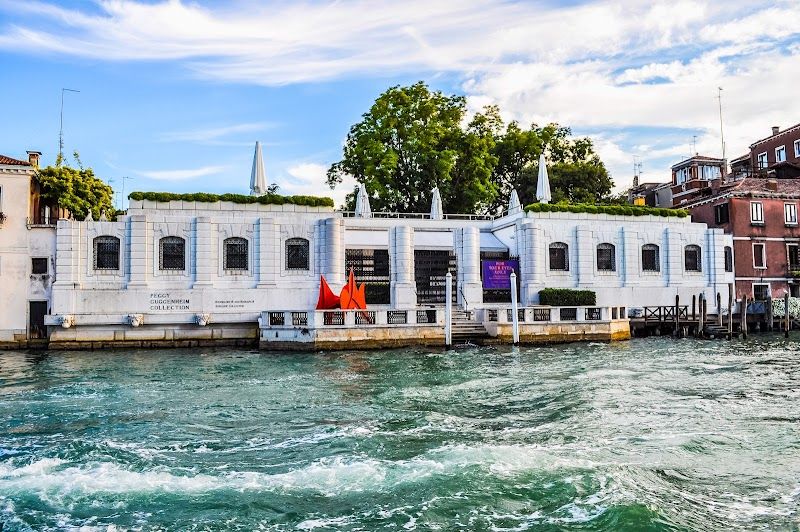
This is Europe's premier collection of 20th century art crammed into an intimate 18th-century palace that feels more like visiting a wealthy collector's home than a sterile museum. You'll see genuine masterpieces by Picasso, Pollock, Rothko, and Duchamp displayed in rooms where Peggy Guggenheim actually lived and entertained artists. The collection focuses intensely on Cubism, Surrealism, and Abstract Expressionism, with nearly every piece being museum-quality rather than filler. The experience feels refreshingly personal compared to Venice's overwhelming churches and palaces. You move through modest rooms where each painting gets space to breathe, then step onto the canal-side terrace for one of Venice's best Grand Canal views. The sculpture garden behind the palace contains Guggenheim's grave alongside her beloved dogs, plus works by Giacometti and Marino Marini's cheeky bronze horseman. Audio guides provide context about Guggenheim's relationships with the artists, making the collection feel alive rather than academic. At EUR 18, this delivers better value than most Venetian attractions because every room contains genuine treasures rather than tourist padding. Most visitors rush through in 45 minutes, but you need 90 minutes minimum to appreciate the density of masterworks. Skip the temporary exhibitions upstairs unless you're an art fanatic, the permanent collection downstairs is where the magic happens. The museum shop has Venice's best selection of art books and prints.
Basilica di Santa Maria della Salute
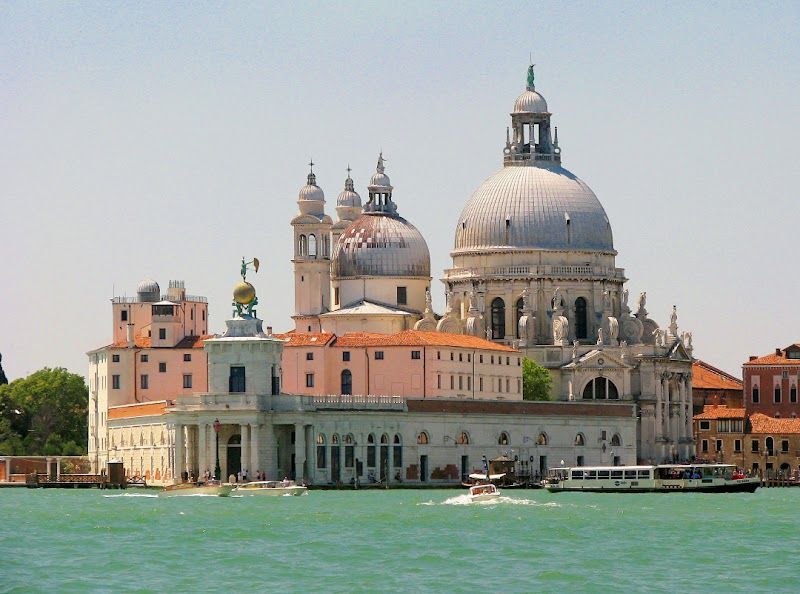
Santa Maria della Salute anchors the entrance to the Grand Canal with its distinctive octagonal dome and twin bell towers, built after Venice lost 80,000 residents to plague in 1630. The real treasure sits in the sacristy: three ceiling masterpieces by Titian showing Old Testament scenes painted when he was 70, plus his altar piece Wedding at Cana. You'll also find works by Tintoretto, but honestly, you're here for the Titians. The main church feels surprisingly spacious inside, with marble floors creating geometric patterns under that famous dome. Most tourists snap photos from the steps outside and leave, missing the sacristy entirely. The lighting inside can be tricky for photos, especially of the ceiling works, and crowds thin out significantly after 4pm. The atmosphere stays reverent despite constant foot traffic, and you'll hear multiple languages echoing off the marble. Skip the main church if you're pressed for time and go straight to the sacristy (5 EUR entry). Most guides don't mention that the best external photos come from the Palazzo Ducale waterfront, not the church steps. The November festival brings massive crowds but creates a unique experience if you're here then. Don't bother with audio guides, the sacristy attendant usually speaks English and knows more than any recording.
Basilica di Santa Maria Gloriosa dei Frari
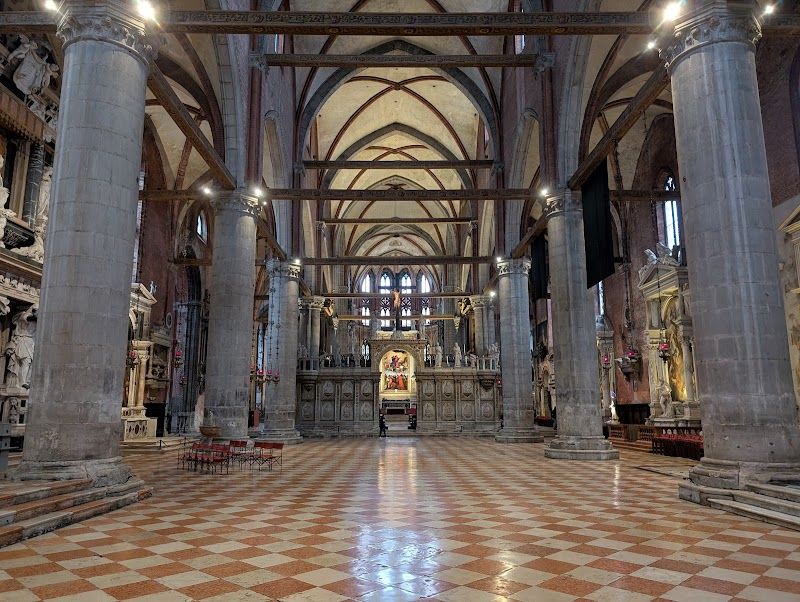
The Frari stands as Venice's largest and most artistically significant church, housing two of the Renaissance's greatest masterpieces within its soaring Gothic walls. Titian's massive Assumption of the Virgin dominates the high altar, a swirling composition that practically glows in the filtered light, while Giovanni Bellini's serene Madonna and Child triptych in the sacristy offers intimate perfection on a smaller scale. You'll also find Titian's own tomb, Canova's pyramid monument, and some of Europe's finest wooden choir stalls carved by Renaissance masters. Walking into the Frari feels like entering a cathedral of art rather than just another Venetian church. The nave stretches endlessly upward, creating dramatic perspectives that frame Titian's altarpiece perfectly. The acoustic qualities are remarkable: every footstep echoes, and when tour groups whisper near the sacristy, their voices carry across the stone floors. Unlike St. Mark's crowds, you can actually contemplate the art here, moving freely between chapels and finding quiet corners to absorb the craftsmanship. Most visitors rush straight to Titian's Assumption and miss the real treasures: spend serious time with Bellini's triptych, which reveals new details up close. The EUR 3 entry fee is Venice's best art bargain, though the Chorus Pass at EUR 14 makes sense if you're church-hopping. Skip the audio guide and use that money for a coffee afterward, the plaques provide enough context for the major works.
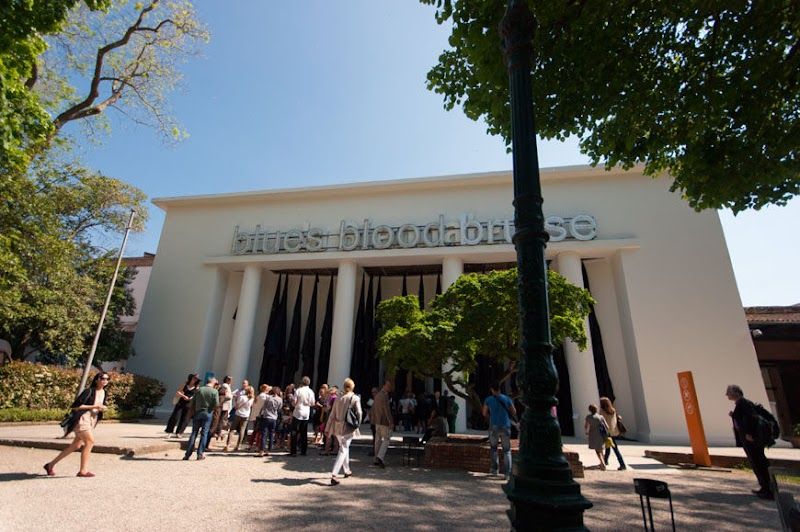
Giardini della Biennale
Enter through the main Giardini entrance and immediately turn left toward the water to start with the Austrian Pavilion by Josef Hoffmann, which many visitors overlook Visit between 2pm and 4pm when the afternoon light filters through the trees and the morning tour groups have moved on The small pavilions near the back corners (Hungary, Romania) are often unlocked even during the off-season, and they offer glimpses of their unique interior architecture
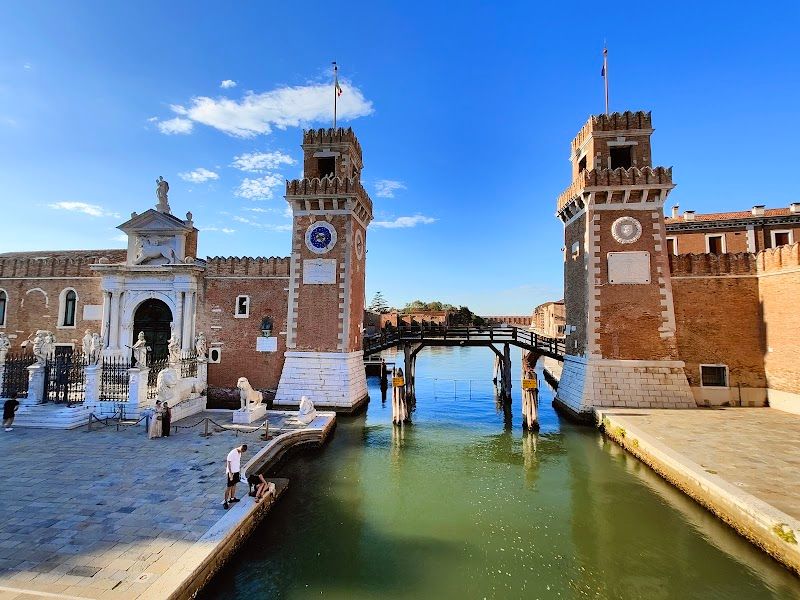
Arsenale di Venezia
The Arsenale showcases Venice's industrial might through its colossal Renaissance gateway, where four ancient Greek lions stand guard over what was Europe's largest shipyard. You'll see the monumental land gate built in 1460, decorated with winged lions and classical columns, plus the carved marble lions looted from Athens' Piraeus harbor in 1687. The complex spans 45 hectares of canals, workshops, and warehouses where Venetian workers once built entire galleys in 24 hours during the republic's golden age. Standing before the gateway feels like confronting a fortress rather than a shipyard. The stone lions, each with different expressions and origins, create an oddly intimate moment amid the grand architecture. You can peer through the iron gates into the vast complex of brick buildings and waterways, imagining the hammering of thousands of workers and the splash of newly launched warships. The scale becomes clear when you walk the perimeter along the fondamenta, where medieval walls stretch endlessly. Most guidebooks oversell this as a major attraction, but honestly, you're looking at a gate and some lions for about 10 minutes unless the Biennale is running. The real payoff comes during odd years (2025, 2027) when the art Biennale transforms the interior into exhibition spaces and you can finally explore the rope factory, shipbuilding halls, and arsenal buildings. Skip the architecture Biennale years unless you're genuinely interested in contemporary building design.
Gallerie dell'Accademia
Enter through the main entrance on Campo della Carità, not the side entrance that many tourists mistakenly use as the main entrance Most visitors tend to rush through the early rooms to reach the famous pieces, but Room 2 features Carpaccio's Miracle of the Cross cycle, which is often overlooked and usually empty The wooden Accademia Bridge right outside provides a classic view of the Grand Canal toward Santa Maria della Salute, making it a prime spot for photos after your visit
Jewish Ghetto of Venice
This is the world's original ghetto, where Venice confined its Jewish population starting in 1516. You'll walk through Campo del Ghetto Nuovo, surrounded by the tallest buildings in Venice (up to 9 stories, built vertically since the community couldn't expand horizontally), and visit five remarkable synagogues through guided tours. The Museo Ebraico tells the story of Venetian Jews across five centuries, but the real draw is seeing synagogues hidden on upper floors of ordinary buildings, each representing different Jewish communities: Ashkenazi, Sephardi, Italian, Levantine, and Canton. The museum feels intimate rather than overwhelming, and the synagogue tours reveal spaces you'd never know existed from street level. You'll climb narrow staircases to discover ornate interiors with hand-carved arks, gilded decorations, and crystal chandeliers that seem impossible in such a confined area. The guide explains how each community adapted their worship space to Venetian building restrictions, creating some of the most ingenious religious architecture you'll see. The contrast between the plain exteriors and elaborate interiors is genuinely striking. At EUR 8 for museum entry plus all synagogue tours, this is exceptional value compared to Venice's usual tourist traps. Most visitors rush through without understanding the architectural constraints that shaped these spaces. Skip the audio guide and stick with the live tours, they run every 30 minutes and the guides know stories you won't read elsewhere. The morning tours are smaller and more personal than afternoon crowds.
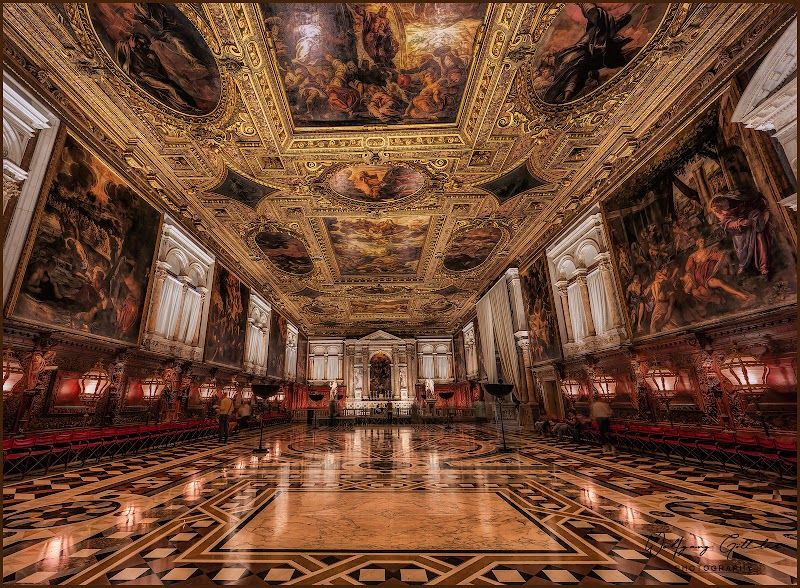
Scuola Grande di San Rocco
The Scuola Grande di San Rocco houses what's arguably Venice's greatest single artistic achievement: Tintoretto's complete decorative cycle covering every wall and ceiling. Unlike most Venetian churches where you crane your neck to glimpse fragments, here you're surrounded by 60 massive paintings that took the master 23 years to complete. The ground floor focuses on scenes from Mary's life, while upstairs showcases the epic Old and New Testament cycles, culminating in the breathtaking Crucifixion that spans an entire wall. You'll climb the elaborate staircase and enter rooms that feel more like stepping inside Tintoretto's mind than viewing paintings in a traditional sense. The upper hall overwhelms immediately: every surface tells a story through dramatic chiaroscuro and swirling figures that seem to move in the changing light. Mirrors are provided so you can study the ceiling paintings without breaking your neck, though most people ignore them and suffer anyway. The atmosphere is reverent but not stuffy, with excellent natural lighting that shifts throughout the day. Entry costs €10, which is exceptional value considering you're seeing one artist's complete vision in its original context. Most guides rush groups through in 45 minutes, but you need at least 90 minutes to absorb the scale properly. Skip the audio guide at €5 extra: the paintings speak for themselves, and the commentary tends toward academic droning. Focus your energy on the upper hall where Tintoretto's late masterpieces reside, though don't miss the tender Annunciation downstairs that shows his softer side.
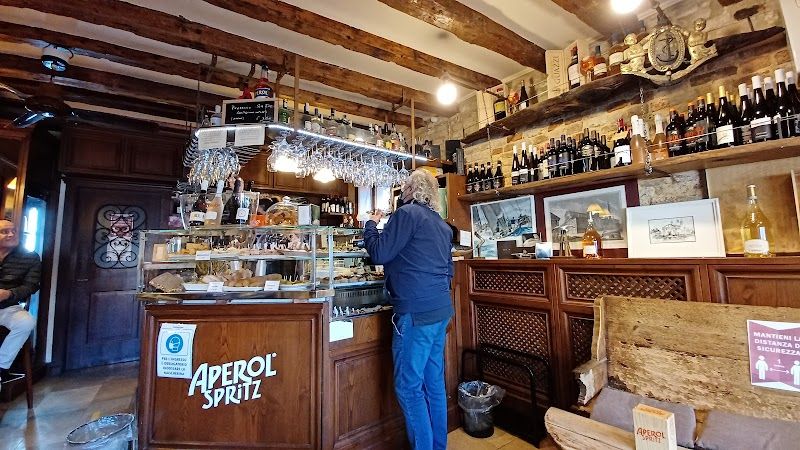
Osteria Al Squero
Bacaro directly facing a working gondola workshop across the canal in Dorsoduro. Stand outside with your cicchetti and spritz watching craftsmen repair gondolas. The baccalà mantecato is excellent, as are the seasonal vegetable crostini and polpette.
Travel Guides
Expert guides for every travel style
Where to Eat in Venice: Bacari, Cicchetti & Fish
How to eat in Venice: the cicchetti and bacaro tradition, the Rialto market fish, the sarde in saor and baccalà mantecato, where to find the good restaurants, and which tourist traps to avoid.
8 min
First Time in Venice: What You Need to Know
Before you go: the day-tripper entry fee, vaporetto passes explained, acqua alta flood alerts, the cicchetti bacaro crawl, luggage on bridges, and why getting lost is the strategy.
7 min
Frequently Asked Questions
Two full days covers the essentials: one for San Marco sestiere (Basilica, Doge's Palace, Campanile, then getting lost toward San Polo for the Rialto market and cicchetti crawl), one for Dorsoduro and Cannaregio (Peggy Guggenheim or Accademia, the Jewish Ghetto, bacari on the fondamente in the evening). A third day lets you add Burano and Torcello (the coloured houses and the Byzantine mosaics, 45 minutes by vaporetto). Two nights minimum, three is better.
Venice charges a day-tripper access fee (EUR 5) on selected days (mostly weekends and peak days April-July). It applies if you arrive between 8:30 AM and 4 PM and are not staying overnight. You book in advance at cfrm.ve.it. If you are staying in a hotel in Venice, the fee does not apply. The fee was introduced to manage overcrowding, not as a general admission price.
Cicchetti are the Venetian small plates: slices of bread with toppings, fried polpette (meatballs), baccalà mantecato (creamed salt cod), sarde in saor (sweet and sour sardines). They cost EUR 1.50-3 each and are served at bacari (traditional Venetian wine bars). You stand at the bar, order an ombra (small glass of house wine, EUR 1.50-2.50) or a prosecco (EUR 2-3), eat 4-5 cicchetti, and move on to the next bacaro. The best are around the Rialto market: Al'Arco, Cantina Do Spade, Do Mori.
Walking and vaporetto (water bus). Buy a 24-hour vaporetto pass (EUR 25) rather than singles (EUR 9.50 each). Line 1 goes the full length of the Grand Canal with 16 stops. Line 2 is faster but misses most stops. The traghetto gondola ferries (EUR 2, standing) cross the Grand Canal at several points between bridges. There are only 4 bridges across the Grand Canal (Scalzi, Rialto, Accademia, Costituzione), so you will walk in circles. This is correct and intended.